


The Tutor Lesson Management Framework: 5 Stages Every Independent Tutor Needs
Published on June 1, 2026
A practical 5-stage framework for managing tutor lessons — from planning and prep to follow-up. Built for independent tutors who want fewer no-shows and better results.
Ask any independent tutor where their week actually goes, and you will hear the same answer: not in lessons. The teaching hours are the easy part. The hours that drain energy are the ones between — sorting tomorrow's schedule, hunting for the right material, writing the parent a recap of what happened on Tuesday, chasing the student who hasn't booked their next slot.
Most tutors call this "the admin side" and try to minimize it. That framing is the trap. The work between lessons is not admin — it is what makes the next lesson worth showing up for. When it is handled well, lessons feel coherent and students stay for years. When it is improvised, every lesson starts cold and students drift away.
This guide introduces a simple framework we use at Learnico to think about that work: The Tutor Lesson Management Framework — five stages every lesson moves through, whether you notice them or not.
The Tutor Lesson Management Framework in 60 seconds
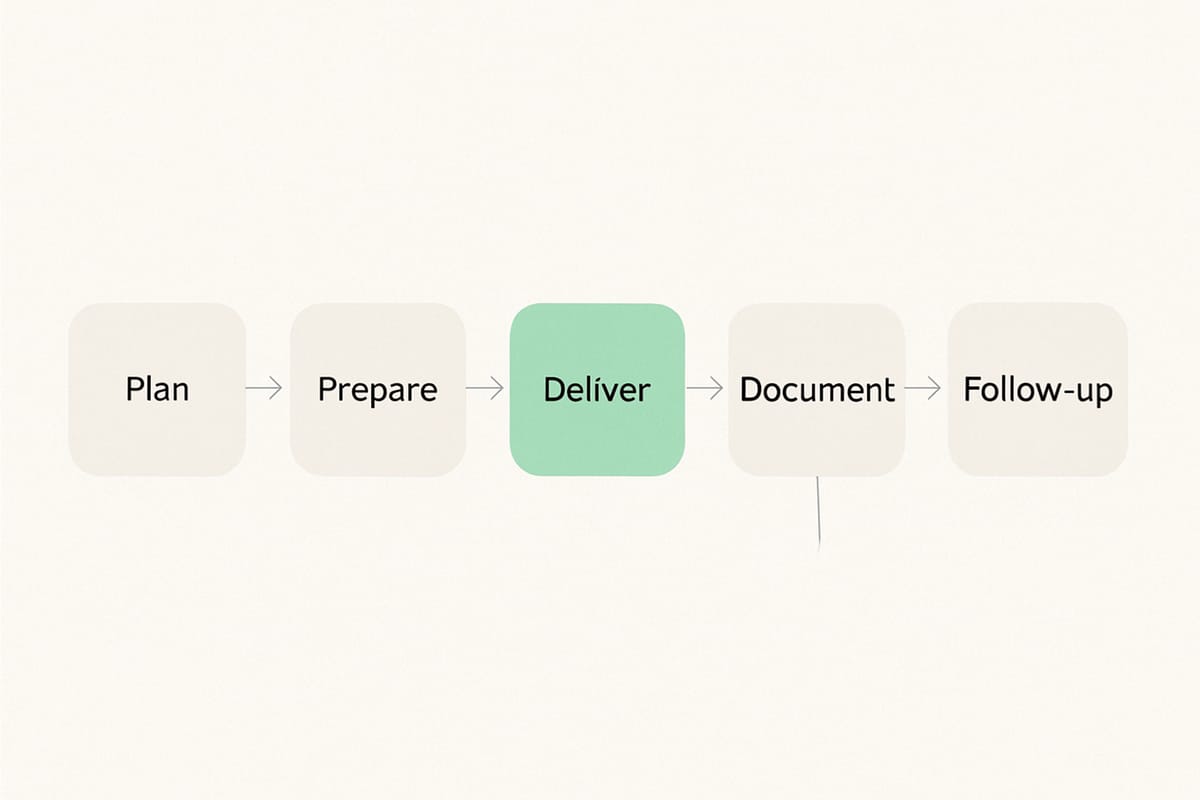
Every tutor lesson moves through five stages: Plan, Prepare, Deliver, Document, and Follow-up. Most independent tutors run lessons through the middle three and improvise the rest. Managing all five — consistently, for every student — is what separates a sustainable tutoring practice from a stressful one.
A practitioner framework from the Learnico team — built around what we see independent tutors actually do (and skip) week to week.
This is the framework we built Learnico around — see how the five stages work together inside one tool.
What is tutor lesson management?
Tutor lesson management is the systematic workflow an independent tutor uses to plan, prepare, deliver, document, and follow up on each lesson. It treats every lesson as a five-stage cycle rather than a single block on a calendar, so that scheduling, prep, delivery, notes, and follow-up reinforce each other instead of competing for the tutor's attention.
It is distinct from tutoring business management — which deals with pricing, marketing, retention strategy, and growth — and from lesson planning, which is the content of a single lesson. Lesson management is the operational layer in between: what happens around every lesson, every week, for every student you teach. We cover the broader business view in our guide to managing a tutoring business.
Why most tutors run lessons, not manage them
A tutor with five students can hold the whole picture in their head. Who paid, who needs prep, who said they wanted to focus on past-perfect this week — it all fits. A tutor with fifteen students cannot. And the moment the picture stops fitting, most tutors do not switch to a system. They keep doing what worked at five, just faster and with more apps open.
In our work with independent tutors at Learnico, the pattern is consistent. The lessons themselves stay strong — tutors who got into teaching because they love their subject deliver good lessons even when the rest is on fire. What suffers is everything around the lesson: prep gets shaved to ten minutes before the call, notes get skipped because there is no time between sessions, the follow-up message that would have kept a student engaged never gets sent.
The problem is not effort or competence. It is the absence of a default workflow. When every lesson is freshly improvised, the tutor pays the cost of decision-making fifteen times a week. A framework — even a loose one — converts those fifteen decisions into one decision made once and reused.
(The first year of running a tutoring practice is mostly about getting students through the door — that is covered in our guide to starting a tutoring business. This article is for the year after that.)
That is what the next section gives you.
The Tutor Lesson Management Framework
Every lesson — every single one, from a one-off SAT prep session to the 47th hour with a returning student — moves through the same five stages:
- Plan — deciding when the lesson happens and how it fits into a recurring rhythm
- Prepare — building or selecting the material, and reloading what you know about the student
- Deliver — running the lesson itself
- Document — capturing what happened while it is still fresh
- Follow-up — connecting today's lesson to the next one
Stages 1, 4, and 5 are the ones tutors skip first when they get busy. They are also the ones that compound. A skipped follow-up makes the next prep harder. Skipped prep makes the next delivery weaker. Skipped notes make every future lesson with that student a guess.
The five sections below treat each stage the same way: what it is for, the principle that anchors it, the tactics that make it work, the mistake we see most often, and how a platform like Learnico can take some of the load off.
Stage 1 — Plan
Why it matters
Planning is the only stage that happens outside the rhythm of a specific lesson. It is the work of making sure that lessons happen at all — predictably, without negotiation, without surprises. Get it right once and the cost approaches zero for months. Get it wrong and every week starts with rescheduling messages.
The core principle
A tutor's calendar should run on rules, not negotiations.
Tactics
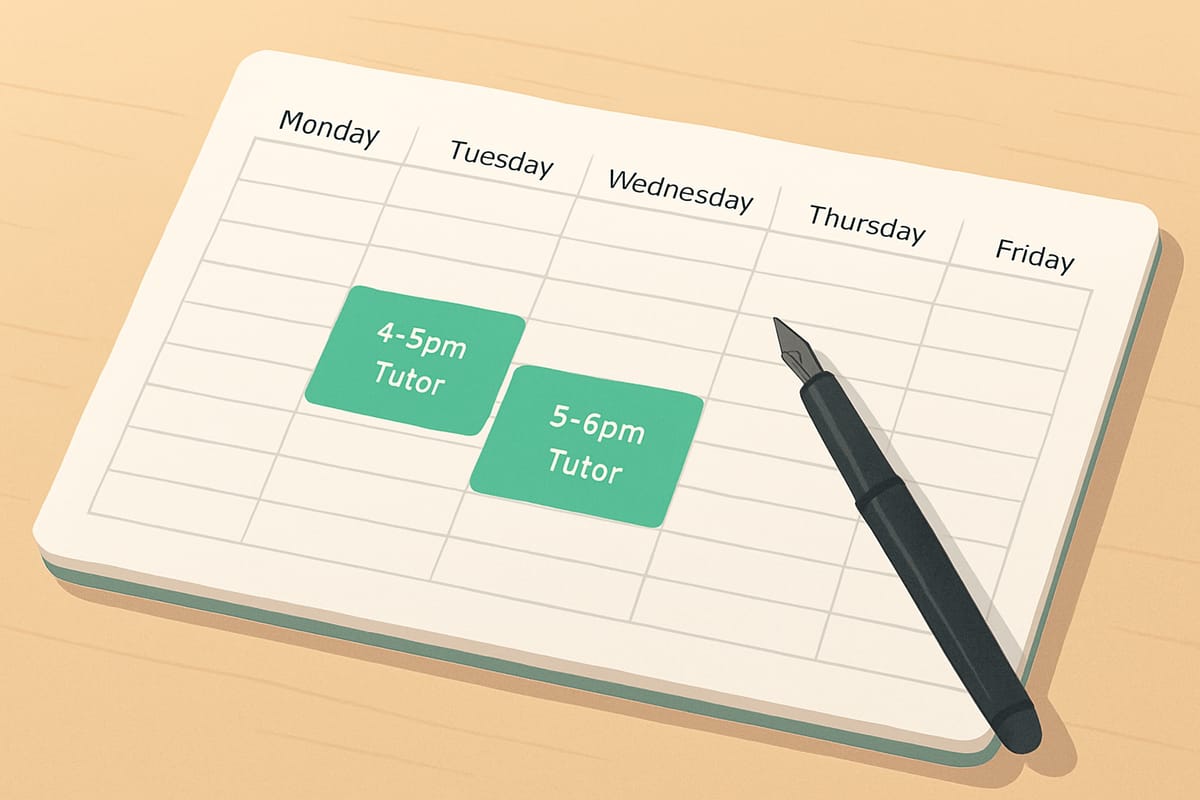
- Set recurring slots, not individual bookings. A student who books one lesson at a time is a student who will eventually stop. A student with a standing Tuesday at 5pm is a student for the year.
- Define a hard cancellation policy and put it in writing. 24-hour notice is the floor. Anything shorter and you carry the cost.
- Block buffer time between lessons. Fifteen minutes minimum — long enough to finish notes from the last lesson and reload context for the next.
- Cap your weekly capacity before students fill it for you. Decide the maximum number of lessons you will teach per week, and protect that cap when demand spikes.
- Make timezone explicit on every booking. One missed timezone every quarter costs an entire lesson's revenue.
Common mistake
Saying yes to every reschedule request. It feels accommodating in the moment, but it teaches students that your calendar is negotiable, which means they will treat it as negotiable. Tutors who hold the line on rescheduling — politely but consistently — report fewer no-shows and steadier income within a single term.
How a platform like Learnico handles this stage
Learnico's tutoring management software turns the planning stage into configuration you set once. Recurring weekly slots, automatic cancellation policy enforcement, timezone handling, and a per-week capacity cap are all built into the booking system — so students can self-serve inside the rules you defined, without you negotiating each slot.
Stage 2 — Prepare
Why it matters
Preparation is where a tutor's expertise becomes a specific lesson for this student. Skipping it does not just produce a worse lesson — it produces a lesson the student has had before, from someone else, for less money. Prep is the moat.
The core principle
Prep is not building material from scratch — it is loading the student's context back into your head.
Tactics
- Re-read last lesson's notes before the new lesson starts. Five minutes. Non-negotiable. This is the single highest-leverage habit a tutor can build.
- Keep a reusable bank of exercises per topic. Preparation should be selecting from a library, not writing fresh material every week.
- Identify the one thing you want the student to leave with. A lesson with one clear outcome lands; a lesson with five blurs.
- Anticipate the question they will ask. Most students return to the same blocker week after week. Prepare for it explicitly.
- Confirm materials work before the lesson starts. Sharing a broken PDF link at the start of an online session burns five minutes of teaching time.
Common mistake
Treating every lesson as a blank page. The tutor opens a fresh document, picks a topic, builds an exercise set from scratch. It feels thorough and it is exhausting — and the resulting lesson rarely beats a polished, reused one that has already worked for ten students.
How a platform like Learnico handles this stage
Learnico keeps each student's history — past topics, materials, notes — one click from the lesson. Prep becomes scanning the last session, picking a reusable resource from your library, and walking into the call already loaded.

Stage 3 — Deliver
Why it matters
This is the stage tutors are best at — it is the reason they started tutoring. But "best at" does not mean "managed". The lessons that go well are not the ones with the most charisma; they are the ones with predictable structure that students can rely on.
The core principle
A reliable lesson shape beats a brilliant lesson every time.
Tactics
- Open with a recap, not a new topic. The first three minutes belong to "where we left off". It re-establishes context for both of you.
- Run no more than three blocks per hour. Recap, new material, practice. Anything finer-grained loses the student.
- Build in a hard checkpoint at the halfway mark. Ask: "Is this making sense?" Then actually pause for the answer.
- End with the next-step preview, not the bell. "Next time we'll look at X" is what makes the student leave the lesson already engaged with the next one.
- Keep time visibly. Either a clock on screen or a glanceable timer. Running over by ten minutes is not generosity; it is a missed transition for everyone involved.
Common mistake
Letting the strongest topic of the lesson eat the schedule. The student is interested, the tutor is enjoying it, suddenly forty minutes are gone and the lesson plan is unfinished. The fix is not to be less engaged; it is to plan for it — protect the back half of the lesson explicitly.
How a platform like Learnico handles this stage
Lesson delivery is mostly outside any platform's reach — it is the tutor's craft. What a platform can do is remove friction around delivery: a working video call that connects on the first try, materials at hand, timer running. Learnico bundles the call, the materials, and the time-keeping into one window so the tutor's attention stays on the student, not on the toolchain.
Stage 4 — Document
Why it matters
Documentation is the stage that quietly determines whether a student stays for one term or three years. Notes are how you walk into the next lesson knowing where you are. They are also how the student (or their parent) sees that progress is real.
The core principle
If you do not write the lesson down within an hour, it did not happen.
Tactics
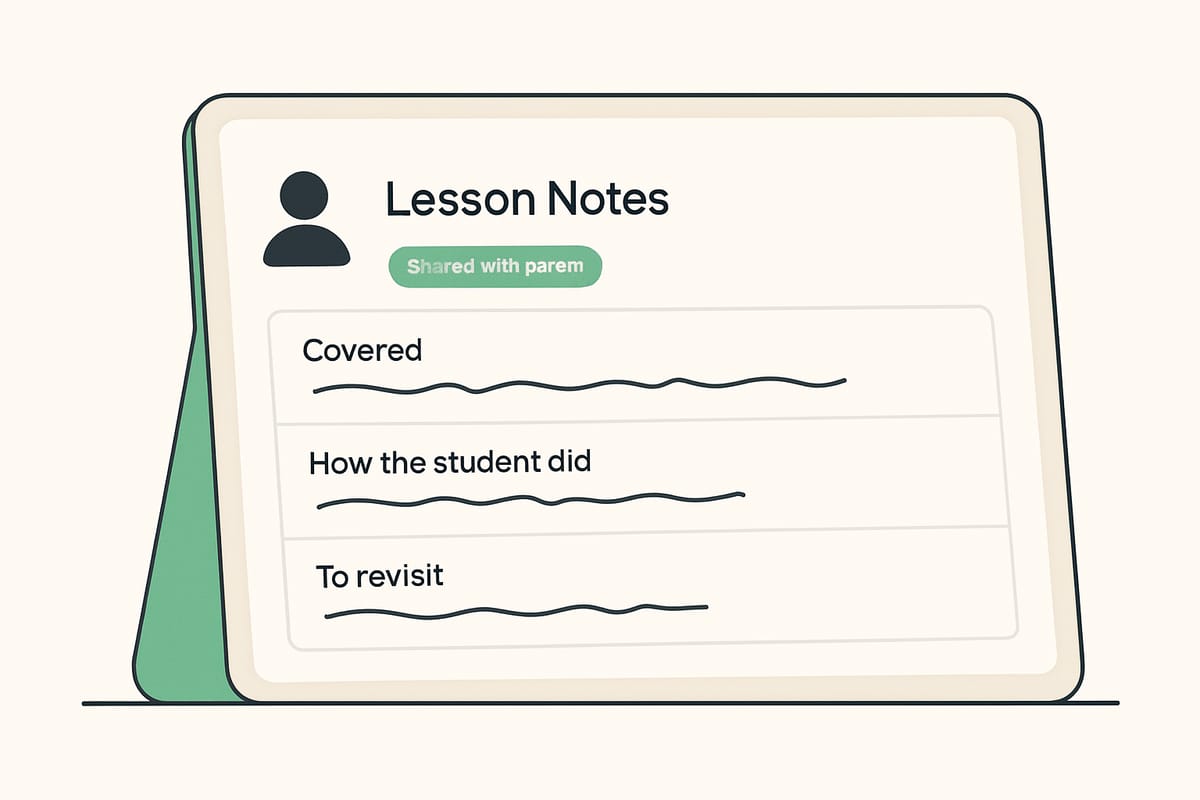
- Capture three things per lesson: what you covered, how the student did, what to revisit. Three lines is enough. Five is generous. Thirty is procrastination.
- Note specifics, not impressions. "Confused conditional past with present perfect" is useful next week. "Did well today" is useless.
- Track recurring blockers separately from one-off difficulties. A topic the student has stumbled on three weeks running is the topic for the next lesson.
- Make notes visible to parents (where appropriate). Younger students and adult learners who report to a manager benefit from a written summary of what happened.
- Mark attendance and payment alongside the note. Not in a separate spreadsheet. The lesson, the note, the payment, the attendance — same record.
Common mistake
Telling yourself you will "remember to write it up tonight". You will not. The lesson that just ended pushes the next lesson into focus, and the note never gets written. The window is the hour after the lesson, not the evening.
How a platform like Learnico handles this stage
Notes, attendance, and payment status live on the lesson record itself in Learnico — so writing the note is one field, not a separate workflow. Parent-visible summaries can be enabled per student, and the recurring-blockers view surfaces what to revisit next time.
Stage 5 — Follow-up
Why it matters
Follow-up is the bridge between today's lesson and the next one. It is the cheapest retention tool a tutor has and the easiest to drop when the week gets full. Tutors who keep the bridge intact keep students for years; tutors who do not lose them quietly, one missed message at a time.
The core principle
Every lesson should end with a small artifact the student can come back to.
Tactics
- Send the recap or homework within 24 hours. Past that, the lesson has faded for the student and the message lands as an obligation rather than a continuation.
- Make the next lesson concrete in the follow-up. "Next Tuesday we'll work on X" is a different message than "see you next week" — the first is engagement, the second is a calendar invite.
- Confirm payment cleanly, without making it the headline. Payment confirmation is administrative; it should not be the emotional last note from a lesson.
- Use follow-up to flag the schedule, not negotiate it. "Your Thursday slot stays as is" is information; "Can we still do Thursday?" is an invitation to reschedule.
- For students you teach long-term, follow up between lessons sometimes too. A short message about something relevant — a useful link, a thought that came up — is what turns a tutor from a service into a relationship. We explore that further in Building Student Relationships.
Common mistake
Bundling follow-up with the next lesson's prep. "I'll send the homework when I prep the next one." By then it is too late — the student has moved on, the message lands cold, and prep gets dragged longer because the follow-up is now part of it.
How a platform like Learnico handles this stage
Recap messages, homework, the next-lesson reminder, and payment confirmation are all wired into the lesson record in Learnico — so once the lesson ends, the follow-up sequence is templated, prefilled, and one click from sent.
A week in the life: applying the framework
Imagine a tutor running twelve recurring lessons per week — three each on Monday, Tuesday, Wednesday, and Thursday, with Friday off. Without a framework, that week is a series of last-minute preps, rushed notes, and missed follow-ups. With the framework, it looks different.
Sunday evening — the tutor spends twenty minutes on Stage 1. The week's schedule is already set (recurring slots, no negotiation), but they confirm any one-offs and check no payments are outstanding.
Monday morning — five minutes of Stage 2 per lesson. They open each student's record, re-read the last note, pick the reusable exercise from their library. Fifteen minutes total for three lessons.
Monday afternoon — Stage 3. Three lessons, each with the same open-recap-deliver-checkpoint-preview shape. Fifteen-minute buffer between them.
Monday evening — Stage 4 happens in the buffer. Three lines per student in the lesson record. Five minutes per note. Done before dinner.
Monday late evening — Stage 5 is templated. The recap, the homework, the next-lesson confirmation. One click per student.
Tuesday looks like Monday. So does Wednesday. So does Thursday. By Friday, the tutor has spent under two hours on the framework outside of teaching — and every student has been planned for, prepared for, taught, documented, and followed up with. That is what lesson management buys.

Frequently asked questions
What is tutor lesson management?
How do independent tutors manage lessons without software?
What is the difference between a lesson plan and lesson management?
How many lessons can one tutor manage per week?
What should a tutor do after every lesson?
Is tutor lesson management software worth it for a solo tutor?
Run lessons, manage the rest
Lesson management is not a separate skill on top of tutoring — it is the same skill, applied to the work that surrounds the lesson. Plan, prepare, deliver, document, follow up. The framework does not make tutoring easier; it makes it sustainable.
If you want to see what the five stages look like inside a single tool — built specifically for independent tutors — that is what we built Learnico's tutoring management software for. The walkthrough is in Getting started with Learnico.

Marta is an independent teacher turned founder. She works directly with independent tutors building Learnico — and The Tutor Lesson Management Framework is distilled from those conversations.