


How to Start a Private Tutoring Business in 2026: Complete Guide
Published on March 27, 2026
Learn how to start a private tutoring business step by step. From setting rates to finding students and managing payments — everything you need in 2026.
How to Start a Private Tutoring Business: Complete Step-by-Step Guide (2026)
Demand for private tutoring has never been higher. According to Fortune Business Insights, the global private tutoring market was valued at USD 66.96 billion in 2025 and is projected to reach USD 72.61 billion in 2026, growing at a 10.42% CAGR through 2034 (Fortune Business Insights).
Whether you want to start a tutoring business from home, go fully online, or combine both, the path from "I'm good at teaching" to "I run a profitable tutoring business" requires more than expertise in your subject. It requires the right structure.
In this guide you'll learn:
- How to choose your niche and define your services
- How to write a tutoring business plan
- What legal and tax requirements to expect
- How to set tutoring rates that actually pay
- How to find your first students and keep them
- Which tools make running your business effortless
1. Choose Your Tutoring Niche
The most successful tutors don't teach everything — they own a specific corner of the market. Defining your niche early shapes every other decision you'll make.
Subject Expertise & Qualifications
Start with what you know best. This doesn't require a formal teaching degree — what matters is demonstrable expertise and results. A software engineer can tutor coding, a university student can tutor high-school maths, and a fluent speaker can tutor a language.
That said, certain markets (exam prep, special education needs) reward certifications, so consider whether credentials would meaningfully raise your rates or open new doors.
Age Group & Level
Think carefully about your ideal student:
- Elementary (ages 6–11): Requires patience, creative materials, and strong parent communication
- Middle school (ages 11–14): Often subject-specific; maths and languages dominate
- High school (ages 14–18): Exam-focused — SAT, ACT, AP exams, IB
- University: Essay coaching, advanced maths, engineering, programming
- Adult learners: Language acquisition, professional skills, career transitions
Each segment has different marketing channels, different pricing norms, and different parent/student dynamics.
One-on-One vs Group Tutoring
One-on-one tutoring is the most common format. It allows complete personalization, commands premium rates, and is easiest to start. The downside: your income is capped by hours available.
Group tutoring (2–6 students) scales your earning potential. A group of 4 paying half your individual rate means you earn twice as much per hour. It requires stronger classroom-management skills and is better suited to structured, curriculum-based subjects.
Many experienced tutors offer both: individual sessions for students who need deep attention, group workshops for revision or exam preparation.
Online vs In-Person vs Hybrid
Online tutoring removes geography entirely. You can work with students anywhere, record sessions for review, and avoid commuting. The private tutoring business from home model has become mainstream — and for many tutors it's simply more profitable.
In-person tutoring still commands a premium in many markets, especially for younger children and students who struggle to focus online.
Hybrid — offering both formats — gives students flexibility and makes your services more resilient to external disruptions.

2. Create a Tutoring Business Plan
A tutoring business plan doesn't need to be a 40-page document. For a solo tutor just starting out, it's a one-page map: where you're going, how you'll get there, and what it costs.
Define Your Goals (SMART Method)
Vague goals produce vague results. Try this instead:
- "I want to earn $2,500/month from tutoring by month six, working a maximum of 25 hours per week."
- "I want 10 regular students within 90 days at an average rate of $55/hour."
Specific, measurable goals let you evaluate what's working and what isn't.
Estimate Startup Costs
Starting a tutoring business from home is genuinely low-cost. Typical startup expenses:
Financial Projections & Pricing
Map out three scenarios — conservative, expected, and optimistic — based on different numbers of students and session frequencies. This exercise often reveals that tutoring is far more profitable per hour than people assume, once you factor in no commuting, no employer overhead, and flexible scaling.
3. Handle Legal Requirements
This is the step most aspiring tutors skip — and it's the one that causes headaches later.
Business Registration
In most countries you have two basic options:
- Sole proprietor: The simplest structure. You operate under your own name, report income on your personal tax return (Schedule C), and face unlimited personal liability.
- LLC (Limited Liability Company): More paperwork, but separates personal and business assets. Worth considering once you exceed roughly $50–60k/year or hire other tutors.
Most independent tutors start as sole proprietors and form an LLC later if needed.
Do You Need a License to Tutor?
In most countries, no formal teaching license is required to operate as a private tutor. You are providing a contracted service, not working in a regulated educational institution.
However:
- In the US, if you work with minors you should complete a state or federal background check — requirements vary by state
- Many tutoring platforms (Wyzant, Tutor.com) run their own background screening
- Teaching English abroad (TEFL) or working in schools requires relevant qualifications
Insurance Considerations
Tutoring business insurance is often overlooked but genuinely important:
- Professional indemnity insurance covers you if a student or parent claims your teaching caused financial harm (e.g., poor exam results they attribute to poor tuition)
- Public liability insurance is essential for in-person sessions in your home or a rented space
- Combined tutor insurance policies are available from around $75/year and cover both
Reputable US providers include Hiscox and specialist brokers like the National Association of Certified Credit Counselors (NACCE) or Next Insurance.
4. Set Your Tutoring Rates
How much do private tutors charge? The range is enormous — from $20/hour for an informal student tutor to $200+/hour for a specialist exam coach in a high-demand subject.
Research Your Local Market
Before you price, research:
- What are tutors in your subject and location charging?
- What's the going rate on platforms like Wyzant, Tutor.com, or Varsity Tutors?
- What premium exists for online tutoring vs local tutoring?
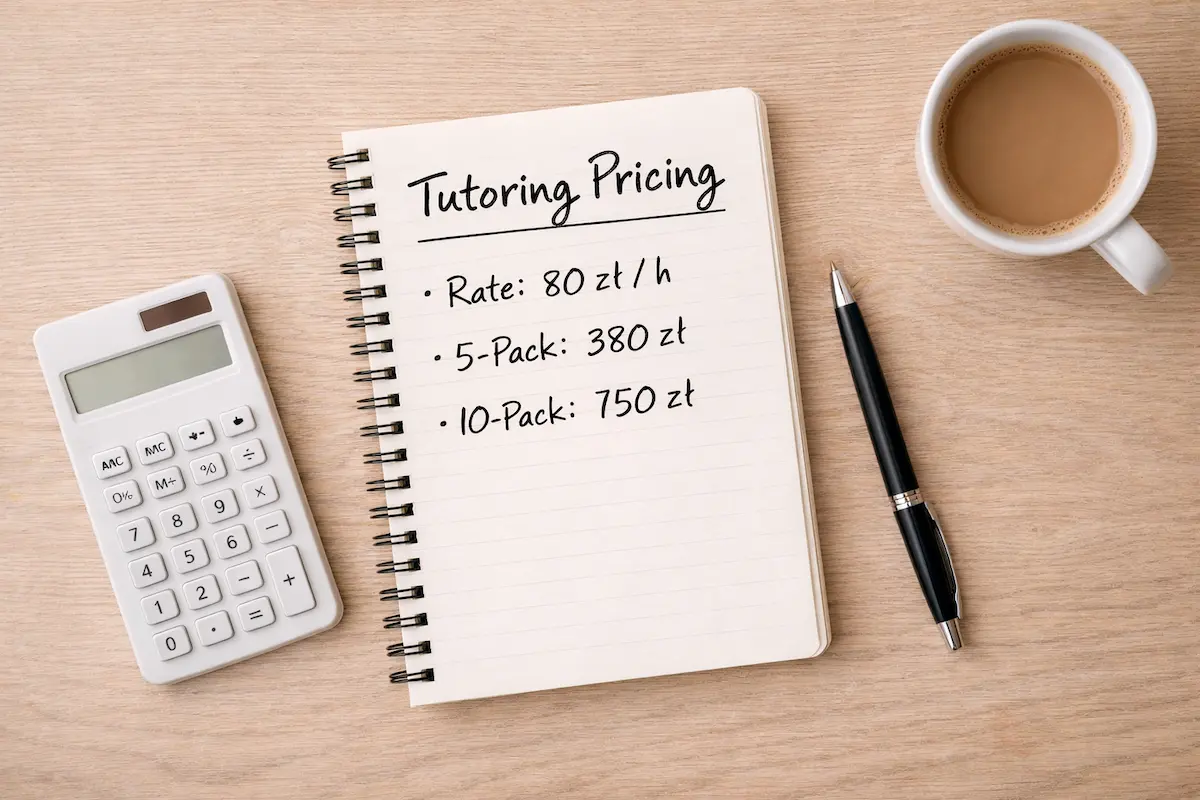
Hourly vs Package Pricing
Hourly pricing is simple and familiar. But it creates uncertainty — students can cancel any time and your income is unpredictable.
Package pricing (e.g., 5 or 10 sessions paid in advance) solves this. It incentivizes commitment, smooths cash flow, and implicitly signals confidence in your ability to deliver results.
A sample tutoring pricing menu might look like:
Raising Your Rates
Don't stay at your starter rate forever. Every 6–12 months, evaluate whether your results, reviews, and demand justify an increase. Most tutors find a 10–15% annual rise is easily absorbed by existing students — especially when framed around added value.
5. Set Up Your Workspace & Tools
Home Tutoring Setup
For in-person lessons at home, you need a quiet, dedicated space. Students (and parents) judge professionalism by environment. A clean desk, good lighting, and distraction-free zone are the basics.
If you're doing online tutoring, invest in:
- A quality webcam and microphone
- Ring light or good natural lighting
- A neutral, professional-looking background
- Reliable internet connection (ideally wired)
Online Tutoring Platforms & Equipment
For the actual lesson delivery:
- Video: Zoom, Google Meet, or Microsoft Teams
- Shared whiteboard: Miro, Bitpaper, or built-in tools
- Document sharing: Google Drive or Notion
- Screen sharing for reviewing student work
Tutoring Management Software
This is where many tutors waste enormous time: managing bookings through WhatsApp, tracking payments in a spreadsheet, sending invoices manually by email, and chasing late payments one message at a time.
Dedicated tutoring management software centralizes everything. Learnico is built specifically for independent tutors — combining scheduling, student management, invoicing, and payment collection in a single platform. Instead of stitching together five different tools, you have one clean workspace that handles the admin automatically, so you can focus on teaching.

6. Find Your First Students
Getting the first few students is the hardest part. Once you have social proof, momentum builds naturally.
Build an Online Presence
A simple website or landing page is essential. It doesn't need to be elaborate — just clear on:
- Who you teach and what subject(s)
- Your background and approach
- How to book a lesson or request a free consultation
- Testimonials (once you have them)
For SEO, include local keywords ("SAT math tutor in Austin") and subject-specific keywords. A Google Business Profile is free and puts you on Maps searches immediately.
Social Media Marketing for Tutors
Social media works well for tutors, particularly:
- Instagram/TikTok: Short teaching tips, exam advice, or study hacks — demonstrates expertise
- LinkedIn: Better for adult learners, professional skills, or corporate language training
- Facebook Groups: Local parent groups are goldmines for finding tutoring clients
Consistency beats virality. Posting once a week for six months outperforms a viral post that isn't followed up.
Local Advertising & Word of Mouth
Don't underestimate offline channels, especially for younger students:
- Flyers on school noticeboards (with permission)
- Posters in libraries, community centers, and cafes
- Cards at local sports clubs and after-school activities
Word of mouth is still the most powerful source of new students. Every satisfied parent is a potential referral source — make it easy by asking directly: "If you know anyone who might benefit from tutoring, I'd really appreciate if you passed on my details."
Referral Programs
A small incentive turbocharges referrals. Offer one free session for each new student referred. The math works in your favor: a single referred student paying $60/month for 6 months is worth $360, easily justifying a $60 thank-you.
7. Schedule & Manage Lessons Efficiently
Poor scheduling destroys tutoring businesses quietly. Missed sessions, double-bookings, and last-minute confusion erode student trust — and your sanity.
Scheduling Tools & Calendar Management
Avoid managing bookings through messages. Use proper tutoring scheduling software that allows students (or parents) to book within your available slots, sends automatic confirmation, and syncs with your calendar.
Learnico includes built-in scheduling that removes the back-and-forth entirely. Students see your availability, pick a slot, and receive an automatic confirmation — no chasing required.
Handling Cancellations & No-Shows
Set a written cancellation policy from day one. Common options:
- 24-hour notice: Full session deducted from package or charged
- 48-hour notice: Session rescheduled at no cost
- Same-day cancellation: Full charge applies
Put this in writing (in your booking confirmation or contract) and enforce it consistently. Students respect clear boundaries — and those who don't aren't worth keeping.
Automating Admin Tasks
Every minute spent on admin is a minute not spent teaching (or resting). Automate:
- Lesson reminders (email/SMS)
- Post-session follow-ups and notes
- Payment collection and invoice generation
- Progress reports to parents
The goal: your business should largely run itself between lessons.
8. Handle Payments Professionally
Talking about money is uncomfortable for many tutors. The solution isn't to avoid the conversation — it's to systematize it so the conversation never needs to happen.
Invoice Templates & Billing Cycles
Every session or package should generate a proper invoice with:
- Your business name / trading name
- Unique invoice number
- Date issued and payment due date
- Itemized sessions (date, duration, rate)
- Total amount and payment methods
Monthly billing works well for ongoing students. Prepaid packages (students pay before the block begins) are even better — they eliminate the awkward "chasing payment" problem entirely.
Online Payment Options
Accept payment by:
- Bank transfer (simple, fee-free)
- Stripe (card payments, professional)
- PayPal (familiar, but higher fees)
- GoCardless (direct debit, ideal for recurring monthly billing)
Offering multiple options removes friction. The easier you make it to pay, the faster you get paid.
Using integrated tutor payment system software (like the payment features in Learnico) means invoices are sent automatically after sessions, payment links are embedded, and you can see outstanding balances at a glance — no spreadsheet required.
9. Grow & Scale Your Tutoring Business
Once your core business is stable, there are several paths to growth.
Track Student Progress
Systematic progress tracking serves two purposes: it makes you a better tutor, and it gives parents evidence that their investment is working. Even simple session notes — what was covered, what needs review, what milestone was reached — make a significant difference in perceived value and retention.
Collect Reviews & Testimonials
After a successful exam result or milestone, ask for a review. Make it easy: send a direct link to your Google Business Profile or a short form. Testimonials on your website and positive Google reviews are among the best tools for finding tutoring clients organically.
Expand Services
Natural growth paths include:
- Group workshops: Exam prep intensives, holiday revision sessions
- Online courses: Pre-recorded content on your subject — earn while you sleep
- Corporate clients: Language training, professional skills, exam coaching for employees
- Digital resources: Worksheets, practice papers, study guides (sold via Gumroad or Etsy)
Use AI Tools for Lesson Planning
AI tools are transforming lesson preparation. For tutors, the best tools for private tutors include:
- ChatGPT / Claude for generating practice questions, explanations, and differentiated materials
- Notion AI for organizing lesson plans and notes
- Learnico's AI lesson planning feature for automated session outlines tailored to each student's level and goals
AI doesn't replace the human element of great tutoring — the rapport, adaptability, and real-time judgment. But it dramatically cuts the time spent on preparation, leaving more energy for the things that can't be automated.
FAQ
How much does it cost to start a tutoring business?
Very little. Starting a tutoring business from home typically costs under $600 — mainly covering a background check, basic insurance, and possibly some software. If you already have a laptop and internet connection, you can start for close to zero.
Do I need a teaching degree to tutor?
No. Private tutoring is an unregulated service in most countries. What matters is your knowledge of the subject, your ability to explain it clearly, and the results you produce. Degrees and qualifications can support your credibility and justify higher rates, but they aren't mandatory.
How do I find students for tutoring?
Start with your personal network — former classmates, family connections, local parents. Then build a Google Business Profile, list on tutoring platforms (Wyzant, Tutor.com, Varsity Tutors), create social media content, and ask satisfied clients for referrals. Most tutors fill their schedule through a combination of these channels within 2–3 months.
Is online tutoring profitable?
Yes — often more profitable than in-person tutoring, since you eliminate travel time and can work with students anywhere. The online tutoring business model scales well: you can tutor international students, run group sessions across time zones, and record sessions for passive income.
What software do private tutors use?
Common tools include Zoom or Google Meet (video), Google Calendar (scheduling), Wave or FreshBooks (invoicing), and dedicated platforms like Learnico that combine scheduling, student management, invoicing, and payments in one place.
How do I set my tutoring rates?
Research what comparable tutors charge in your subject and location. Factor in your experience, qualifications, and the results you deliver. Start slightly below market rate if you're new, build a portfolio of reviews, and raise rates after 6–12 months. Package pricing (prepaid blocks of sessions) works better than pure hourly for most tutors.
Conclusion
Starting a private tutoring business in 2026 is one of the most accessible paths to self-employment. The barriers are genuinely low, the demand is growing, and the income ceiling is real — experienced specialist tutors routinely earn $100–200+/hour with fully-booked schedules.
The difference between tutors who thrive and those who burn out usually isn't teaching skill — it's systems. A solid tutoring business plan, clear pricing, reliable scheduling, and professional payment handling are what turn great teaching into a sustainable business.
If you're ready to stop juggling tools and start running your business properly, Learnico offers a free trial — built specifically for independent tutors who want everything in one place.
Your expertise is the product. Let the tools handle the rest.